Our process
Eight steps from the first walk to handover
A sequence that keeps a working lot working and puts grade and drainage ahead of surface.
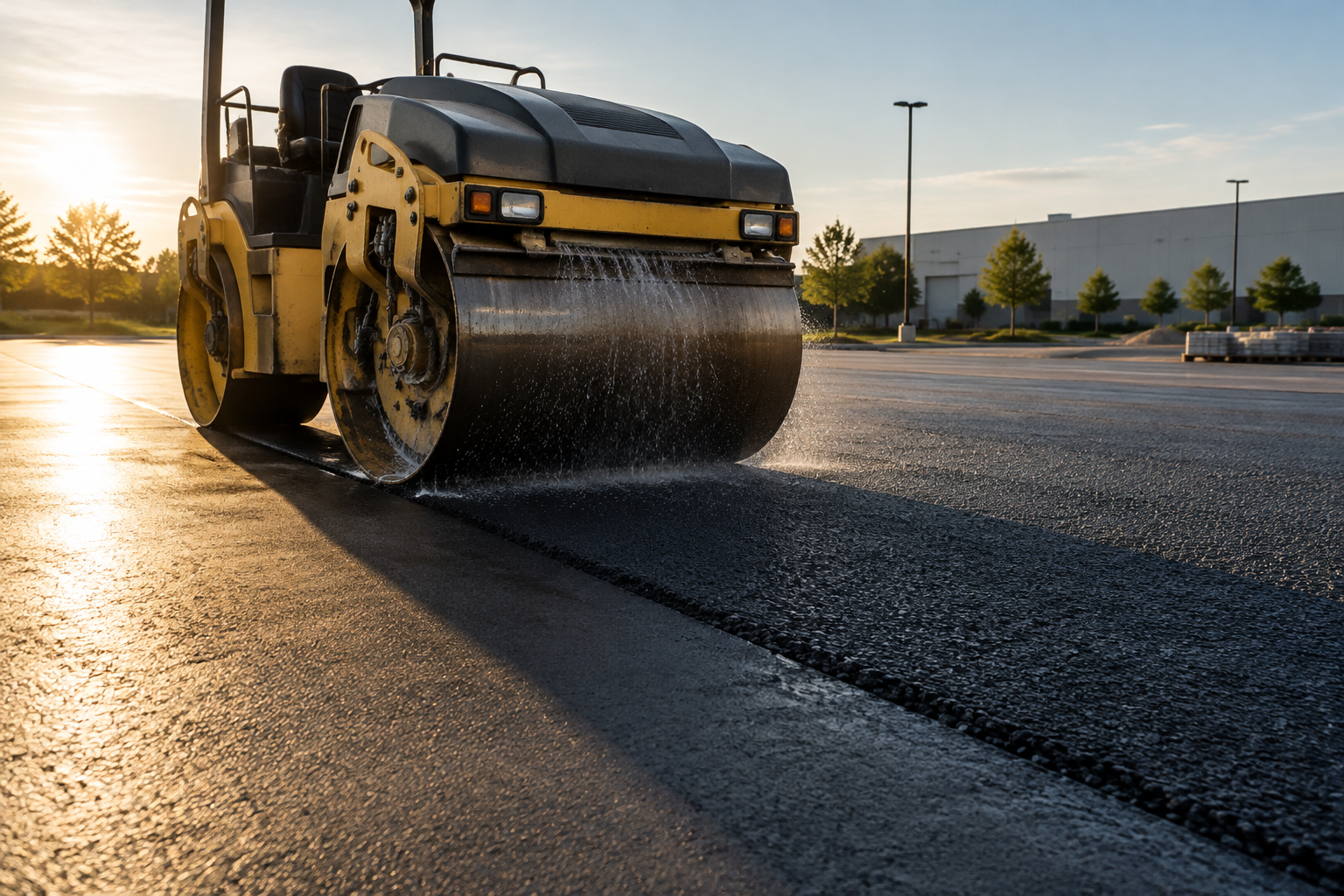
Paving a commercial lot is a sequence, and the order matters. Base work that is rushed shows up as settlement. Rolling that happens too late shows up as a porous surface. Paint applied too early shows up as a layout that fades within a season. The process below is the order we work in, and the reasons for it.
01Consultation and site visit
The first conversation is about the lot, not the product. How is it used, how many vehicles, what arrives in a truck, which tenants need access and when. Then a site visit: surface condition, cracking patterns, base condition where it can be seen, drainage fall, catch basins, aprons, curbs, islands, lighting bases and access routes for equipment.
We look at the lot in the state it is actually in, including the low spots that only show after rain. Where it helps, we ask for what you already have: an old drawing, a site plan, a maintenance record. Anything that shows where water was meant to go makes the assessment faster.
02Written scope
The scope sets out the limits of the work in plain terms: what is being removed, what is being repaired, what is being added, the base preparation, the drainage items, the number of lifts in general terms, the phasing and the exclusions. Anything not in the scope is not in the work, which is the point of writing it down.
The scope also names what the lot will look like at handover, and what you will need to arrange on your side: tenant notice, garbage bin relocation, lighting or signage changes, and any approvals the property requires.
03Access and phasing for a working lot
A commercial lot rarely goes out of service. The phasing is built section by section so that a route stays open, accessible stalls stay close to the doors, and deliveries can still reach the building. Where a section has to cure without traffic, that work moves to after hours or a weekend.
The plan also sets the equipment route. A paver, a roller and a tri axle need room to work and to turn, and on tight urban lots that decides the order of the sections rather than the other way around.
04Grade and drainage
Before any asphalt is placed, the base is brought to a consistent plane at the intended fall. Low spots are corrected, high spots are removed, and the water is directed toward the catch basins rather than the base of a curb or the door of a unit.
Where a basin has settled or its apron has broken away, that work happens now. A new surface laid over a basin set at the wrong height simply moves the puddle a few metres.
05Paving and compaction
Hot mix is placed and rolled inside a workable temperature range. The rolling pattern is set to close the surface and reach the density the base and the mix allow, with the joints and edges given the attention they need because those are where water and plow blades get in first.
On an overlay, the existing surface is prepared first: cleaned, milled or levelled where needed, and tack coated so the new lift bonds rather than sits on top as a separate layer.
06Cooling time
A fresh mat has to cool before it takes traffic. The time depends on the lift thickness, the air temperature and the wind, so it is judged on site. On a phased lot, the cooling period is the reason a section is closed overnight rather than reopened in an hour.
Keeping vehicles off during that window is what protects the surface. Turning wheels on a mat that is still soft marks it permanently, and those marks stay for the life of the lot.
07Line painting
Layout comes before paint. Stall dimensions, drive aisle widths, arrows, accessible stalls and fire lanes are marked out and checked against how the lot is actually used and against what the property requires. Only then is the paint applied, on a clean, dry, cured surface.
Good layout adds usable stalls and takes away the awkward ones. It is also the step that makes the finished lot read as finished.
08Final walkthrough
The last step is a walk of the lot with you: the limits, the drainage points, the painted layout and anything to watch over the first season. You get the notes for the next maintenance decision, including which areas are worth crack sealing and which are worth watching.
If something does not read as planned, that walk is when it gets raised and resolved.
Materials, in general terms
Most commercial lot work uses hot mix asphalt produced at a plant and delivered to site, placed in one or two lifts depending on the scope and the base. Reconstruction uses a granular base compacted in layers before the asphalt. Overlays use a prepared, cleaned and tack coated existing surface. Sealcoat is a surface treatment applied to asphalt that is sound enough to benefit from it, and crack sealant is a flexible material placed into a cleaned crack. The mix design and the thicknesses belong to the scope of a specific lot, and they are set with the condition of that lot in mind.
What we do not promise
We do not promise a lot that never cracks. Asphalt cracks. What the work can do is give the surface the base, the fall and the compaction it needs so that cracking stays a maintenance item rather than a reconstruction. Where a lot is past the point of an overlay, we will say so rather than sell a surface that will not hold.
Process questions
It depends on the project. Area, number of lifts, base repairs, drainage work, phasing and weather all change the schedule. What we can give you before the work starts is the sequence, the phasing and the limits, so the lot can be managed around it.
The limits of the work, the base preparation, the drainage items, the lifts and materials in general terms, the phasing, the access arrangements and what is excluded. It is written so that two people reading it would describe the same job.
Large or heavily repaired lots are usually phased over more than one stage so that traffic keeps moving and the base work is done properly. Small repairs and sealcoating can often be completed in a single visit.
The mat is rolled while it is still workable and then has to cool before vehicles and plows can use it. That cooling period depends on the lift thickness and the weather on the day, so it is set on site rather than promised in advance.
Last, after the asphalt has cooled and the surface is ready to take paint. Painting before that wastes the layout and the paint, and it is the step that makes the lot usable.
Book the site visit
Send the lot details and the hours it has to stay open. That is enough to plan the first walk and the shape of the scope.
Or email
info@commercialpavingottawa.com