Service area 12
Asphalt paving in Merivale
Dealership display areas, service yards and plaza lots along a corridor where the pavement is on show.
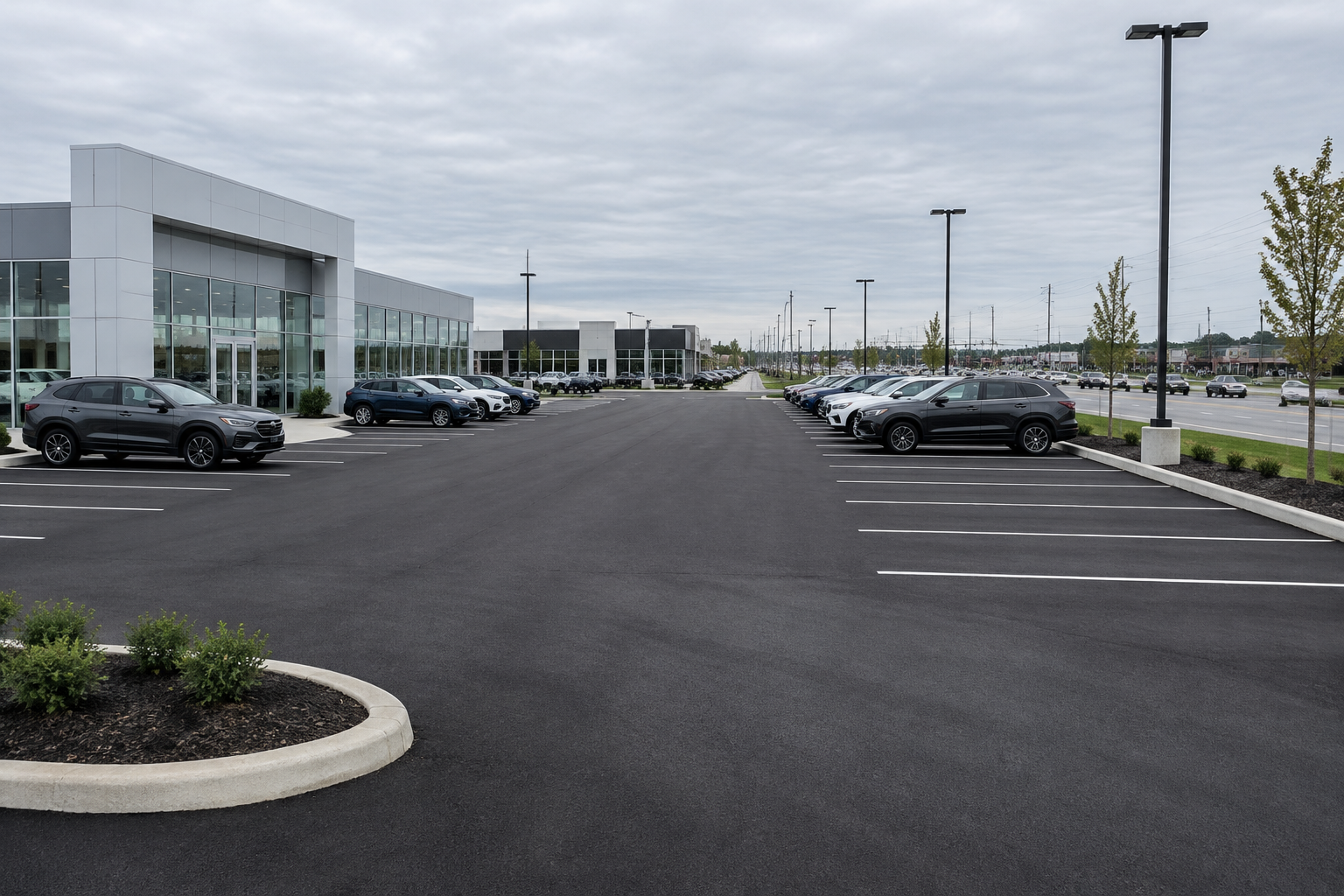
The Merivale Road corridor has one of the densest concentrations of commercial pavement in the city: dealership display areas, service yards, retail plazas and restaurants, all with frontage on the same road. On a corridor like this the condition of the lot is part of how a business reads.
Dealership display areas
A display area is a different surface from a parking lot. Vehicles turn slowly on it, stop on it, and are moved frequently across the same few metres. That slow turning at full lock works the surface, and where the mat is not dense or the base has softened, the aggregate starts to unravel in the places vehicles pause.
Because the area is visible, the finished surface carries weight beyond its function. A patch on a display apron should read as part of the surface rather than as a repair, which means cutting it square, matching the depth and rolling it properly instead of filling the hole.
Service yards behind the frontage
The yard behind the showroom is the opposite kind of space: less visible, more heavily loaded. Vehicles move through it all day, often at tighter angles, and the drive lane to the service bays takes concentrated turning. Both areas get attention, but the scope for each is different and they are assessed separately.
Plaza and restaurant lots
Along the same corridor the plazas carry a mix of short stay and long stay parking. The stalls nearest the doors turn over constantly, the outer rows barely move, and the drive aisle takes the combination of both. That produces uneven wear, which is why a condition map is more useful than a single judgement about the lot.
Entrances and salt
Entrances on Merivale carry heavy traffic and a lot of winter salt from the road. The first few metres inside each entrance take the worst of it, and the apron is usually the first area to break up. Repairing it properly, with the base corrected and the transition restored, prevents the failure spreading inward along the entrance lane.
Scheduling the work
A short closure is often the cleanest option on a dealership or a plaza with a large display area, because a section can be completed and cured in one stage rather than being worked around inventory. Where a lot cannot close, the work is phased by area with a route kept open.
Paving and overlays happen in the warmer months, with striping at the end once the surface has cured enough to take paint. On a display area the layout is marked out and reviewed before painting, because the stall pattern there follows the business rather than a standard layout.
Merivale lot questions
Yes. Dealership display areas and service yards are part of the work. The display area carries a lot of slow turning and stopping on the same pavement, and the service yard behind it takes heavier vehicle movement, so the two areas are looked at separately.
Yes, and it is often the cleanest way to do the work. A short closure lets a section be completed and cured in one stage rather than being patched around the inventory, which is usually faster overall.
Standing and turning wheels work the aggregate at the surface, and if the mat is not dense or the base has softened, the surface starts to unravel in exactly those spots. It shows first where vehicles stop and turn most often.
It follows the layout the property uses for display rather than a parking stall pattern, so it is marked out and reviewed before painting. Where a layout change would help, that is decided at the marking stage.
Start a project on Merivale
Tell us whether the work is a display area, a service yard or the public lot. Each one is scoped and scheduled differently.
Or email
info@commercialpavingottawa.com