Service area 11
Asphalt paving in Kanata North
March Road business park campuses with wide lots, concentrated traffic lanes and quiet evenings to work in.
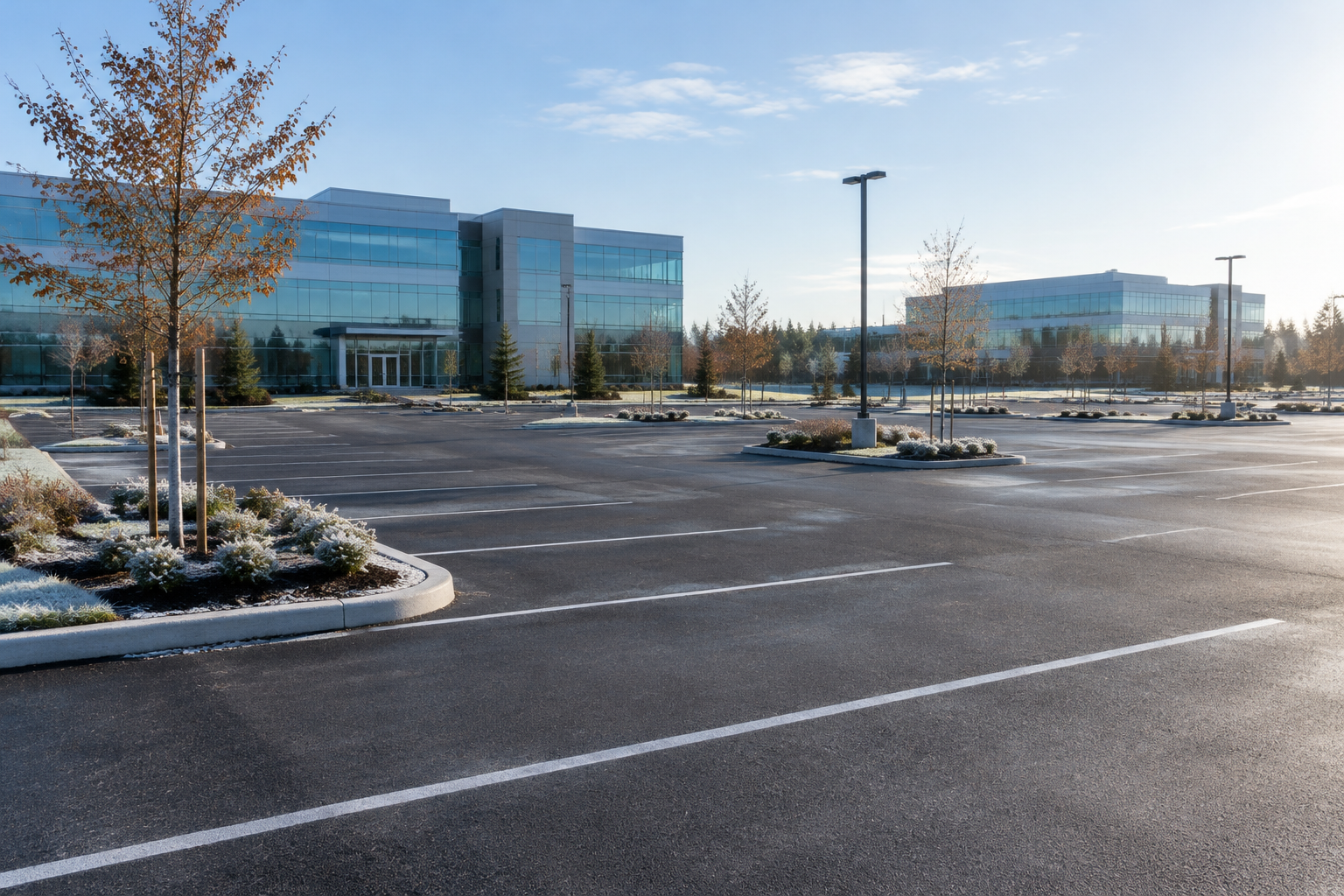
The Kanata North business park is built around large office campuses with wide parking fields. The lots hold a lot of cars during the day and almost none in the evening, which makes them the most schedulable commercial lots in the city. The work is also concentrated in a way that is easy to misread.
Traffic that concentrates
A campus lot does not wear evenly. The lane from the entrance to the main doors carries nearly every vehicle that uses the property, while the outer rows may only fill on the busiest days. After several winters of that pattern, the entrance lane and the drive aisle to the door show wear that the rest of the field does not.
That makes a lane based scope sensible. Repair and overlay the lanes that carry the traffic, correct the drainage where it has moved, and leave the sound outer rows with crack sealing and fresh lines. It costs less than doing the whole field and it addresses the part that is actually failing.
Working around shifts
Where a site runs shifts, the lot fills and empties on a fixed pattern. The work is programmed between those windows, and the section being worked is finished and reopened before the next shift arrives. On most campuses that means working in the evening and into the night, which is also when the surface has cooled enough from the day's sun to take new asphalt comfortably.
Entrances and the winter load
The entrance apron is the hardest worked part of a campus lot. Every vehicle crosses it, salt arrives with them, and plow blades work the same area all winter. It is also where the pavement meets the public road, so the transition has to be built to take both loads.
Where the apron has broken up, the repair is planned as one piece: the failed asphalt is cut out, the base corrected, and the transition restored so vehicles are not crossing a lip twice a day.
Drainage on a large field
Large lots usually drain to a series of basins along the low side, and each one is an interface between concrete and asphalt. When a basin settles, water stands across several stalls before freezing, and the asphalt around the frame breaks up. Adjusting basins and aprons to the surface height belongs in the same scope as the paving, not in a separate visit later.
Planning across the season
Campus lots are usually planned well ahead, because the quiet windows are known and the scope can be split across two seasons without disruption. Paving happens in the warmer months, striping follows once the surface has cured, and the crack sealing program runs late in the season when the cracks have opened.
Because the lots are quiet in the evening, a site visit in the late afternoon is often the most useful: the day's traffic pattern is still visible on the surface, and the areas that carry the load are easy to see.
Kanata North lot questions
Yes. Campus lots in the Kanata North business park are usually large, well spaced and quiet outside working hours, which makes evening and weekend work the most efficient approach.
They set the window. If a site runs shifts, the lot fills and empties at fixed times, so the work is programmed between them and the section being worked is reopened before the next shift arrives.
Because traffic concentrates there. The lane from the entrance to the main doors takes almost everything, while the outer rows may be barely used. Repairing by lane rather than by area is often the most cost effective approach on a campus.
Yes. One entrance stays open throughout, and the entrance apron itself is worked early in the morning or across a weekend so that staff arriving for a shift always have a route in.
Start a project in Kanata North
Tell us which lanes carry the traffic and when the site is empty. On a campus lot the quiet window is the whole plan.
Or email
info@commercialpavingottawa.com