Service area 05
Asphalt paving in Gloucester
Mid life plaza lots around Innes and Blair, the retail rows in Beacon Hill and Blackburn, and the rear service lanes that take the real load.
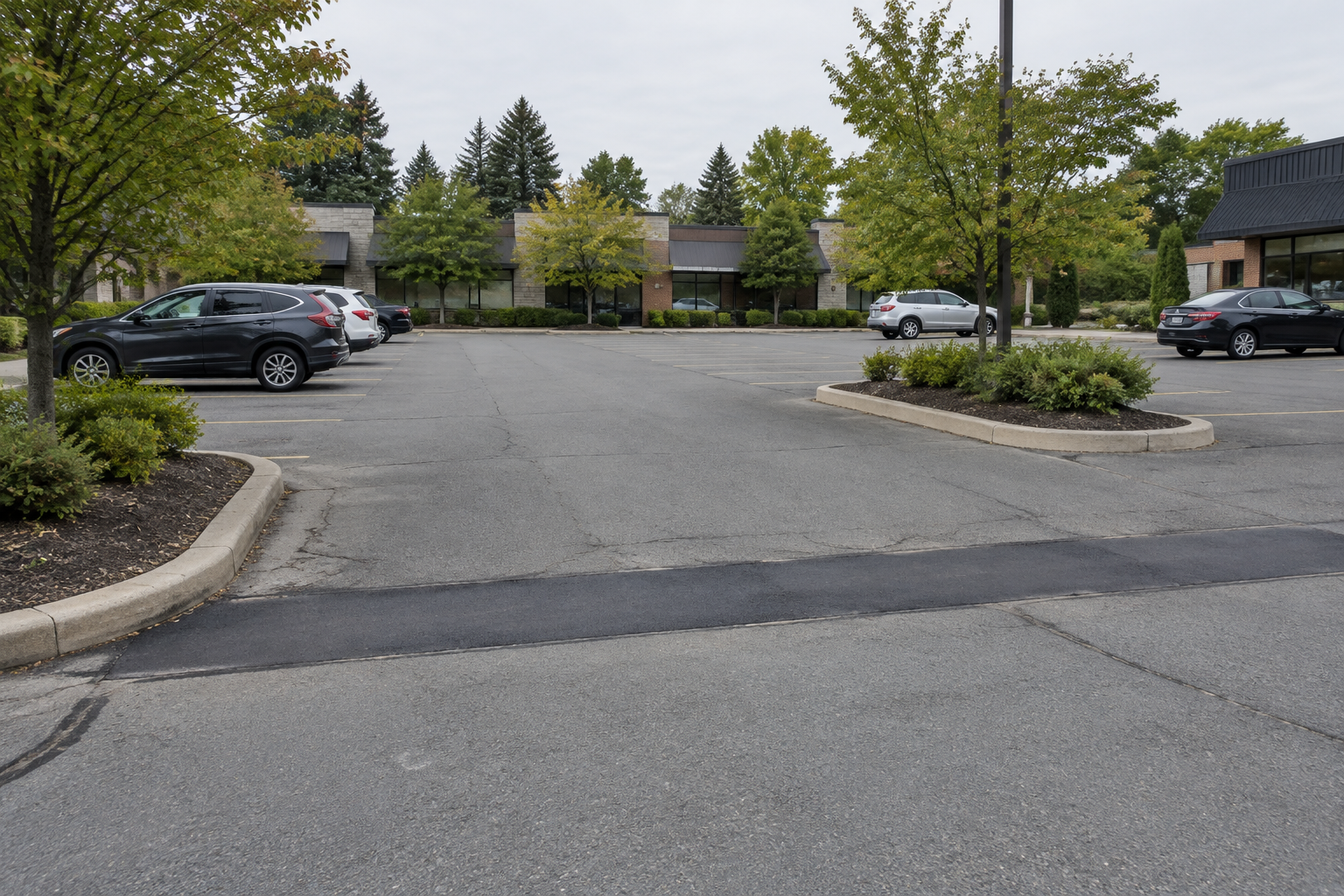
Gloucester sits between the newer east end commercial development and the older inner suburban lots, and the pavement reflects that. Some properties are twenty years into their service life with a full maintenance history. Others are recent builds with only a few seasons behind them. The work on each is different.
The two lot types
The older plaza lots around Blair and the Beacon Hill and Blackburn retail rows generally have a surface that has been patched repeatedly, drainage that has shifted, and stall lines that have been repainted over the same faded marks more than once. The newer pads are in better shape but often show settlement where utility work was done and joints that have opened at the concrete interfaces.
Reading which of these a property is tells you where the money should go. On the older lots, a drainage correction and a targeted repair list usually delivers more than an overlay applied over a base that is still wet in places.
Rear service lanes
The back of a Gloucester plaza is where the load actually lands. Garbage trucks stop in the same spot every week, delivery vehicles turn in a tight radius, and the asphalt in that lane carries more weight per square metre than the front parking field ever will. When a rear lane fails, it is usually a defined strip rather than the whole area.
Repairing it means cutting out the failed strip, correcting the base, and restoring the surface flush so a loaded vehicle has something level to drive on. Leaving a low patch there turns it into a puddle that keeps coming back.
Drainage and the low corner
Many of these lots drain to a single basin at one end, and the fall was designed when the lot was built. After years of patching, the low point has often moved. Water stands in a stall row a few metres from the grate, and every freeze-thaw cycle works at the asphalt around it.
Resetting the basin and apron and restoring the fall in that corner is a small scope with a large effect. It also stops the same corner being patched every spring.
Access and phasing
Innes and Blair properties carry steady traffic and are usually close to a transit route, which adds turning and stopping to the entrance wear. The work is phased by row with one entrance kept open, and the busiest entrances are completed early in the morning. Where a property has two entrances, the program uses one while the other is worked, which keeps the site reachable at all times.
Spreading the scope across seasons
On larger Gloucester properties it often makes sense to split the work. The worst field is repaved and the drainage corrected in the first season, and the remaining area gets its own scope the following year. That approach keeps each phase small enough to manage around tenants and spreads the cost without leaving a half finished lot.
Paving still happens inside the warmer months, and the assessment is best done in spring so the work can be booked into the season. Striping and layout come at the end of each phase, which is also the natural point to fix a stall pattern that no longer fits the tenants.
Gloucester lot questions
Yes. Those properties are a mix of older plaza lots and newer commercial pads, and the approach differs between them. On the older lots the work usually starts with drainage and base repairs; on the newer ones it is more often joints and settlement.
A rear lane that has failed usually needs a narrower scope than the front lot: cut out the failed strip, correct the base, and restore it flush so delivery vehicles have a level surface. It is a small area but it takes more load than the parking field.
It changes the traffic pattern rather than the work. Entrances near a transit stop see more turning and stopping, and the pavement there wears differently. Those areas are noted during the site walk and included in the scope where they need it.
Yes, and it is often sensible. The worst field is done first, the drainage corrected, and the rest of the lot left for the following season with its own scope. That spreads the cost without leaving the lot in a half finished state.
Start a project in Gloucester
Tell us which part of the lot fails first. The rear service lane and the low corner are usually where the real problem shows.
Or email
info@commercialpavingottawa.com