Service 01 / Paving
Parking lot paving in Ottawa
New commercial lots and full reconstruction, built from the subgrade up and handed over ready for striping.
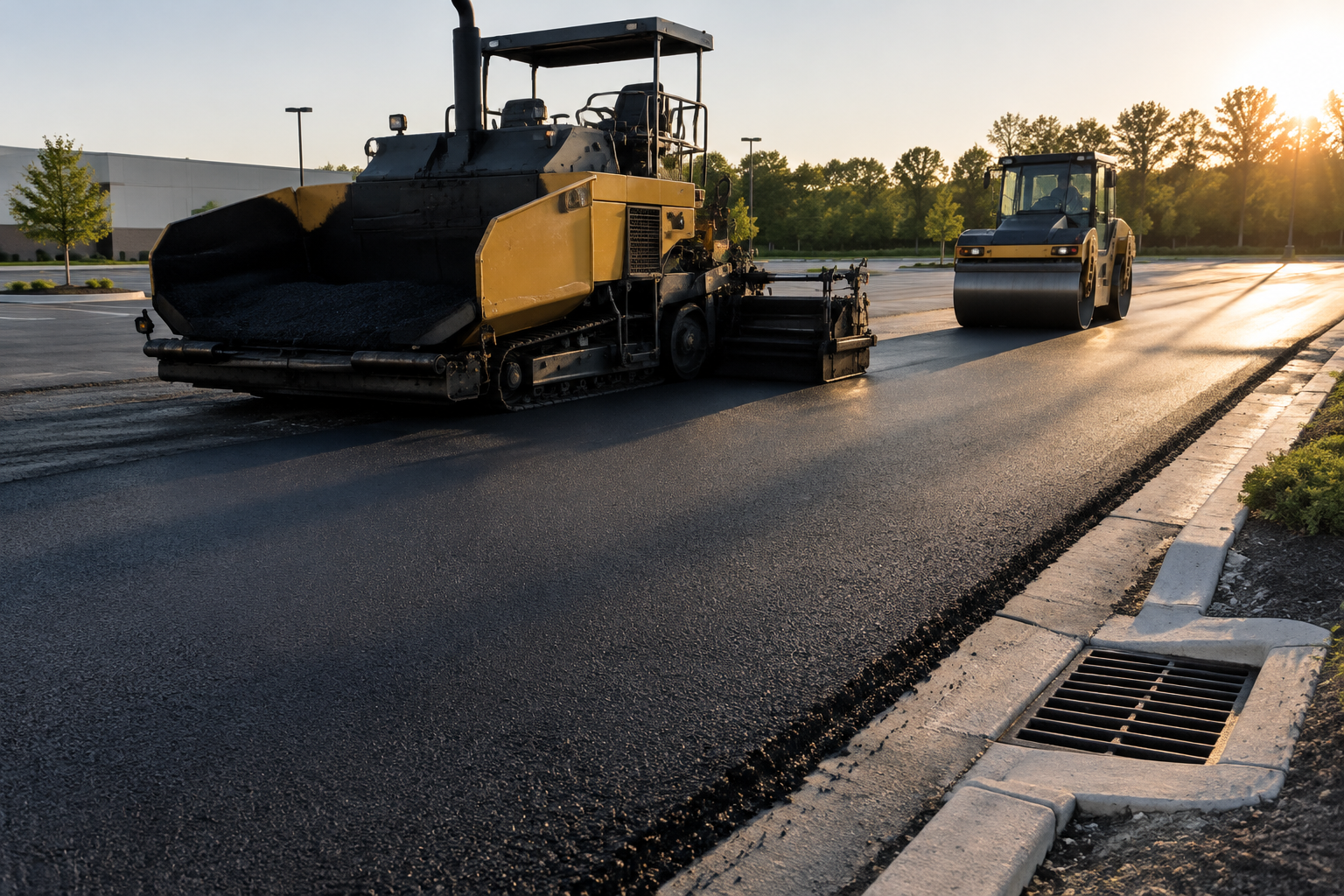
A parking lot is a structure with a surface on it. The surface is what people see, and the structure is what decides whether the surface is still sound after ten winters of plowing, salting and freeze-thaw. Parking lot paving is the work of building both.
What the scope covers
On a new lot the sequence starts below the surface. Topsoil and organic material are stripped, the subgrade is shaped and compacted, and the granular base is placed in layers and compacted to a consistent density. Curbs, islands and catch basins are set to the elevations the design calls for. Then the asphalt goes down in the lifts the scope specifies, each one rolled while the mix is still workable.
On a reconstruction the same sequence starts with removal. Existing asphalt is broken and hauled out, failed base is taken out and replaced, and the lot is rebuilt to a working fall. Where the old lot drained badly, that is corrected here, because a new mat laid on the old grade will hold water in exactly the same place.
- Subgrade stripping, shaping and compaction
- Granular base placed in layers and compacted
- Drainage items, curbs and islands set to elevation
- Asphalt placed in lifts and rolled to density
- Lot handed over clean and ready for striping layout
Access decides the plan
Before anything is scheduled, we work out how the equipment gets in and where it can stand. A paver needs a run long enough to lay a straight mat, a roller needs room to turn at the end of it, and trucks need a route in and out that does not block a fire lane or a loading door. On a tight urban lot that planning is the difference between a workable sequence and a lot that cannot be built as drawn.
On an occupied property the work is phased so that a route stays open, accessible stalls stay near the doors, and deliveries still reach the building. Sections are completed and reopened in order rather than left half finished.
Grade and drainage
Water is the reason most lots fail early. The fall has to move water to a catch basin rather than to the base of a curb, a building door or the middle of a stall row. On a new build that is set before the base is finished. On a reconstruction it is set while the base is being rebuilt, and the basins and aprons are checked so the low point is where the water actually arrives.
Ottawa conditions
Commercial lots here go through hard freeze-thaw cycles, plow blades that catch any raised edge, and salt through the winter. Edges, joints and the interface at curbs and basins are where that damage starts, so they get the attention in the build. Compaction that closes the surface is what limits how much water gets in to begin with.
When to schedule
Paving happens in the warmer months, when hot mix can be produced, delivered, placed and rolled within a workable temperature range and the base is dry. New lot construction is usually planned well ahead so the paving stage lands inside that window rather than at its edge. If a lot has to be ready for a specific date, the base work is scheduled backwards from the paving, not forwards from the start.
Parking lot paving questions
Subgrade preparation, granular base placed and compacted in layers, curbs and islands where the design calls for them, drainage items set to the right elevation, and the asphalt placed in the lifts the scope specifies. The lot is handed over ready for striping layout and paint.
A new lot has no pavement at all, so the base is built from the subgrade up. A reconstruction removes the existing asphalt and rebuilds the base under the same footprint. Both end the same way, with a surface placed on a base that has been brought back to a consistent density and fall.
By working in sections and keeping one route open at all times, with accessible stalls close to entrances. Where the sequencing cannot avoid closing a section, that section is done after hours or overnight so tenant traffic is not cut off.
It depends on the project. The area is only the starting point. Base condition, depth of reconstruction, drainage work, curb and island work, access, phasing and the season all change the number. A site visit and a written scope come before any figure.
Placing asphalt on a saturated base traps water under the mat, and that water finds its way back up. If the base is wet, the work waits. The same applies to a surface that is holding standing water at the time of paving.
Start a parking lot project
Send the lot location, the approximate area and what the site is now. If there are drawings, attach them when we reply.
Or email
info@commercialpavingottawa.com