Service area 10
Asphalt paving in Trainyards
Large retail parking fields on Industrial Avenue and Sheffield, where the sequencing matters as much as the paving.
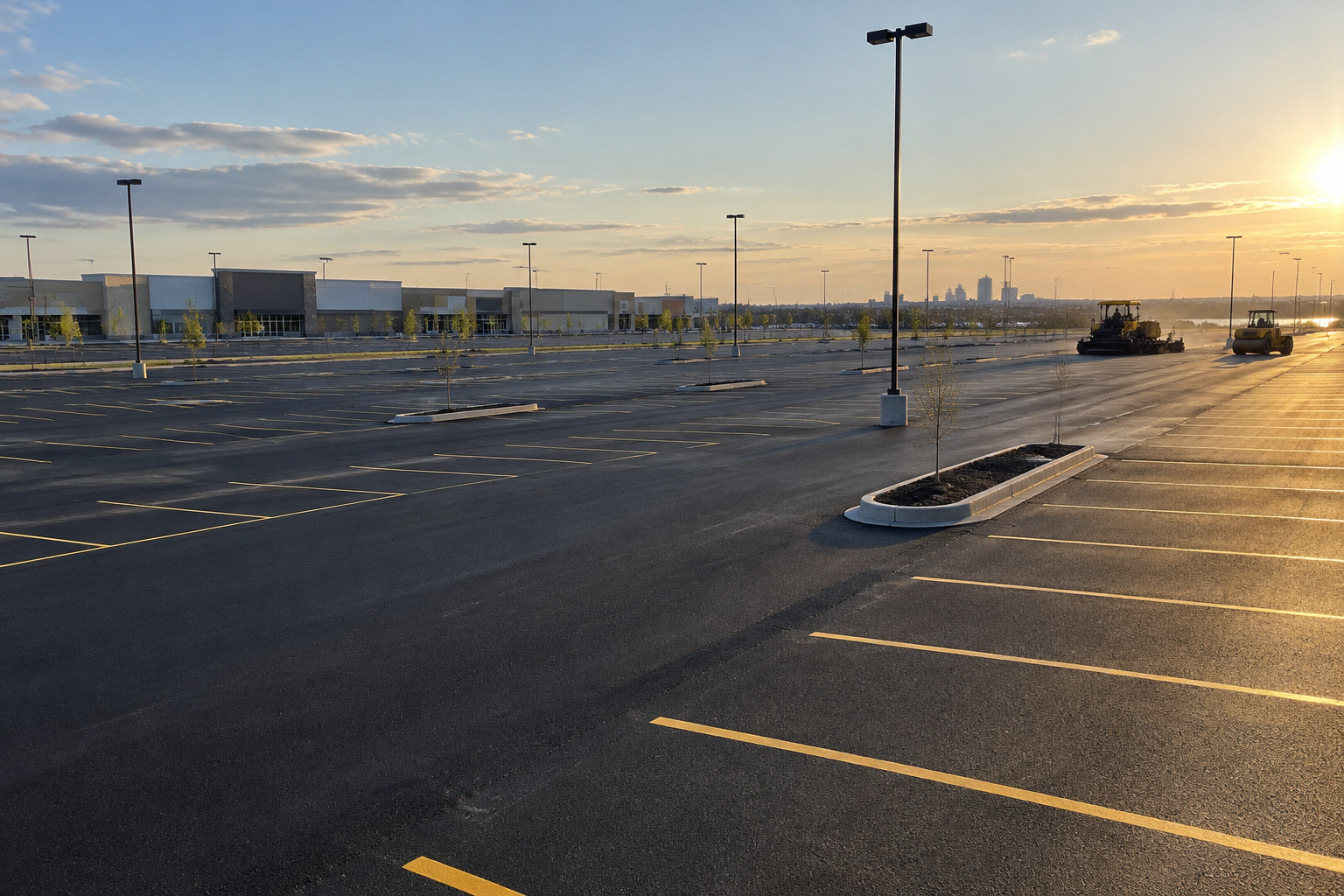
The Trainyards area and the streets around Industrial Avenue and Sheffield hold some of the largest parking fields in the city. A field of that size is never out of use, and it cannot be closed. Paving it is a sequencing problem before it is a paving problem.
How a field this size is planned
The first step is a condition map. The field is walked and divided into areas by what each one actually needs: reconstruction here, an overlay there, crack sealing and striping in the rows that are still sound. That map is what turns a large lot into a series of manageable scopes rather than one big decision.
The second step is the route. Every tenant has to keep a way from an open entrance to their frontage, and the accessible stalls have to stay near the doors of the units that need them. The rows are then programmed in an order that satisfies both, one section at a time, each completed and reopened before the next is cut.
Truck traffic on Industrial and Sheffield
The lots along Industrial Avenue and Sheffield carry more than cars. Delivery vehicles and trailers turn in those drive lanes, and the corners where they turn take a different kind of load from a passenger car aisle. On those sections the base and the joints get more attention, and the repair approach is heavier than in a retail row.
Light standards, islands and drainage
A large field has a lot of fixed objects: light standards on concrete bases, island curbs, catch basins at the low points, and often a private road running through the middle. Each one is an interface where the asphalt has to meet something else, and those interfaces are where water and plow blades do their work.
Basins are adjusted to the new surface height when a section is overlaid, and the fall around each one is checked. A field with a basin set a few centimetres low holds water across several stalls, and that is a repair that gets bigger every winter it is left.
Working hours
Retail fields are busiest at the end of the week and quietest early in the morning. The heavier stages are programmed into the quiet hours, with the work set up so that a section can be finished and reopened before the field fills. On a field this large, the overnight stage is normal rather than exceptional.
Scope by area, not by habit
The most useful thing about a large field is that its areas fail at different rates. The entrance rows and the drive lane in front of the anchors wear first. The outer rows may still be in reasonable condition. Scoping the work by condition means the money goes where the wear is, and the sound areas are left with crack sealing and fresh lines instead of a new surface they do not need.
Paving itself still happens inside the warmer months, with the base dry and the mix placed and rolled in a workable temperature range. On a field of this size, the schedule is usually set early in the year to secure the season.
Trainyards lot questions
By row and by entrance. The field is divided into sections, each one completed and reopened before the next is cut, and at least one entrance stays open at all times. On a field this size the sequencing is the project, not the paving.
It has to, in practice. Retail fields of this size serve several anchors at once, so the work is planned so that every tenant keeps a route from an open entrance to their frontage throughout the program.
They carry heavier vehicles. The drive lanes there take truck traffic and trailer turning, so the base and the jointing get more attention than in a parking field used mainly by cars.
No. It is common to scope the work by the condition of each area: repair the worst rows this season, overlay the middle, and leave sound areas with crack sealing and striping. That spreads the cost and keeps the field usable.
Start a project in Trainyards
Tell us the size of the field and which rows fail first. A condition map is the first step on a lot this large.
Or email
info@commercialpavingottawa.com